What have we learned from the projects of the Amfiteatru Foundation?
Competencies, trust, and team spirit are the foundation of any local development. For the Amfiteatru Foundation, human infrastructure means networks of skilled people, solid collaborations between communities and institutions, as well as the ability to unlock or leverage the resources of each place. Without trained people and mutual trust, no change lasts over time. Our projects in education, training, and inclusion have taught us several principles that we constantly apply in everything we build alongside schools, authorities, employers, and partners.
The beneficiary is never alone
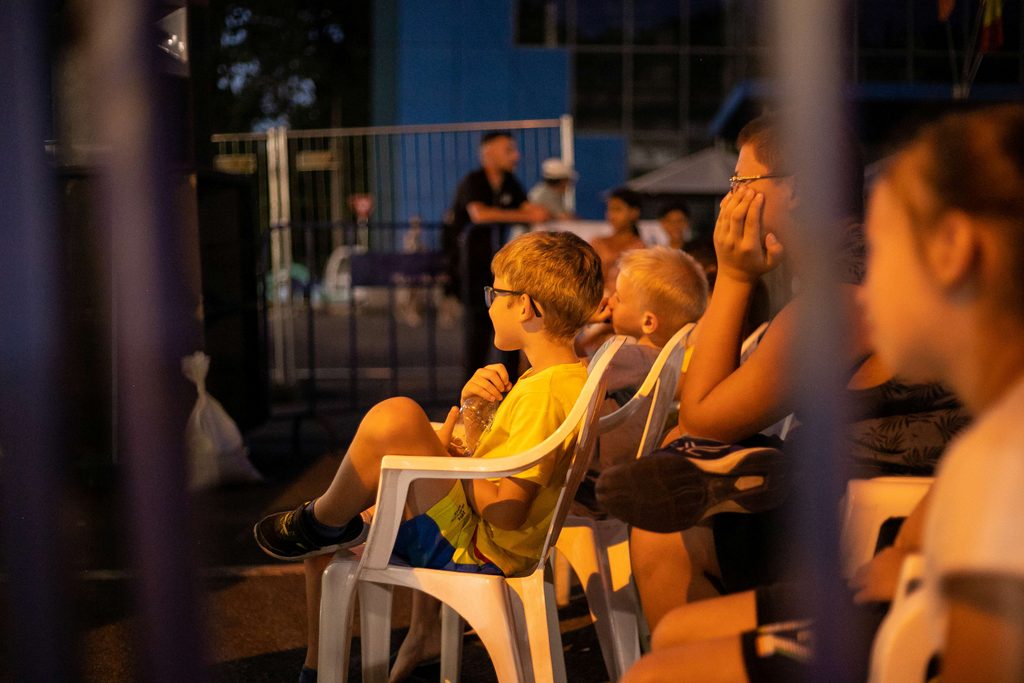
Field experience has shown us that no person goes through a change by themselves. A child’s presence at school depends directly on parental support, trust in a mentor, teachers’ openness, and the atmosphere in the community. When you work with just a single group, the results remain limited.
The project “School Makes Us Better” in Belin (Covasna) put this vision into practice, bringing together 204 Roma students, 10 mentors, 50 parents, and 10 teachers. We combined practical workshops and educational services with parental education and individual mentoring. We applied the same approach in Letca Nouă (Giurgiu), where activities dedicated to children ran in parallel with meetings for parents and teachers.
The conclusion we carry forward is that human infrastructure is built within the circle of student – family – school – community, not just around the child. Right from the design phase, we need to map the actors who support or block participation and provide a concrete role for each of them.
Without real conditions of access, participation remains theoretical
Social, emotional, and educational competencies cannot be separated from the material conditions in which people learn. For a family with limited resources, simple things like school supplies, a warm meal, appropriate clothing, or transportation make the difference between presence and absence. Material support does not replace education, but it creates the minimum conditions without which education remains inaccessible.
In the projects in Belin and Făgăraș, the Foundation provided packages with school supplies, clothing, and hygiene kits, as well as 7,344 food portions during the activities. The project in Olt County adds, in turn, logistical support and the materials necessary for learning, alongside educational, recreational, social, and mentoring activities.
Because of this, a question we now ask ourselves at every budget and for every schedule: not just “what competencies do we want to develop?”, but also “what prevents people from participating consistently?”.
Training starts with the right choice
Another pillar of human infrastructure is the support given to people to orient themselves in a changing labor market. Our objective is to respond to the real needs of participants and employers.
The process has shown us that the first step is always guidance, meaning understanding existing skills, career aspirations, available time, and real market opportunities..
The project “Skill Development for Career Excellence – Center Region” addresses 601 employees and provides professional counseling for all of them prior to training programs, which are subsequently differentiated: from strategic management and commercial worker qualification, to IT courses, human resources clerk, or short modules on communication and sales in the digital age. At the end of the training courses, participants receive a nationally recognized certificate and guidance for their next career step.
Sustainable inclusion relies on institutions, not just on projects
Change cannot remain exclusively the responsibility of beneficiaries or non-governmental organizations. It becomes sustainable only when local institutions learn to work better together with the community, and people have spaces and tools to organize themselves and express their needs.
Between 2022 and 2024, the Jilava City Hall and the Amfiteatru Foundation implemented an intercultural development program with professionals from public institutions, students and teachers, community members, and community organization structures. The program aimed at reducing poverty and Roma inclusion, preventing school dropout, professional development, and improving health status, with special attention to women and youth.
The most important lesson we learned is that the transfer of competences to local partners must be thought out from the beginning, not left for the final stage of a project. We need professionals who develop their competences, institutions that clarify their roles, and mechanisms through which problems can be identified and solved together.
The infrastructure that remains in the community
Human infrastructure is recognized in the child who returns to school because they have support, in the teacher who works with new methods, in the adult who clarifies their professional path, in the institution that learns to collaborate, and in the community that discovers its own resources.
The Foundation’s projects address the entire environment around each person. We facilitate real access to education, begin training with careful guidance, and develop local autonomy instead of creating dependence on a project. In all these endeavors, our partners play an essential role, whether we are talking about field needs analysis, identifying local resources, feedback on the labor market, or continuing collaboration after funding ends. Our objective for the next stage is to apply these lessons more and more often: through connected initiatives, strong local alliances, and continuous attention to the real impact of our work. Future partnerships will bring value by transforming projects into sustainable skills and resources that permanently remain in the community
Photo credit: Alex Iacob